Showing posts with label Classical Music. Show all posts

July 10, 2012

La Scala


We've been in Europe for an entire week now, and still have about a week left. So far, it has been five nights in Paris, one night in Lyon, two nights in Geneva (with a day trip to Fribourg), and now Milan for two nights. We are planning on doing Florence for one night, and finally Rome for 3 nights. Lots of knowledge gained from this trip, and I especially enjoy the relatively diminutiveness of the cities.

Upon getting into Milan tonight, it was already past 6 pm and we didn't have very solid plans. We decided to go walk to La Scala since that was arguably the reason for us coming to Milan in the first place.


When we got there, we started noticing that people were still going in for a performance that night. We inquired about tickets, and were told that Massenet's Manon was playing. It would be 98 euro for each person to sit in a box. That was definitely more than we were willing to spend, and as we discussed whether to purchase, the ticket guy said, actually, we can have the tickets at 78 euro apiece. We were confused by the sudden drop, but still thought the price was high. Without even giving us much time to think about it, he lowered the price again, this time to 43 euro for both of us combined. We jumped at that price, and he told us that we would have to hurry, since the performance was already starting (it was 7:32 and the performance started at 7:30).

We ran to the entrance area, but the usher would not let us in. Specifically they would not let me in. Since Milan was very hot (consistently in the 90's) and we knew we would mostly be walking, both of us wore t-shirts and shorts. Their dress code required men to wear long slacks. After a few minutes of arguing with the head manager, the younger ushers urged us to just go to H&M and buy some cheap pants. Since we had box seats, they could seat us at any time.

We went back outside and actually were about to give up and return our tickets. Then we saw a side entrance with only younger ushers. They had no problem with our clothes, and we made it in! We literally ran through La Scala's staircases to make it to our box - we only missed about 10 minutes total.

These are probably the best seats I've ever had for any musical performance. We had a private box on the right side, 2nd floor from the ground and 8th box from the stage. Great view and the acoustics were fantastic as well. The seating at La Scala is interesting - there were very few seats on the ground floor (or their "Galleria"), and most of the seats are in box seats surrounding the sides and the back of the theater.

Manon the opera was great, although the story was not my favorite. Interestingly, the tenor that played the lead role, Matthew Polenzani, was also the lead in La Traviata at the Met, which we had seen just a few months ago as part of the Met at the Movies series.


Because we were both still in our tourist clothes, we felt very out of place within the theater. We didn't go out much, and Celia went out to buy some food and wine to bring back (I feared being seen by the manager and getting thrown out).

I think given the circumstances (a famous opera house, the incredible seats, the challenging situation to get in), this will end up being our most memorable highlight of the trip.

September 28, 2011

Mahler 2 and the New York Philharmonic

I've been working in New York for 14 months now, and I have amazingly managed to dodge the New York Philharmonic during this time. I've seen the Met a couple times, countless chamber music performances, and even the Ballet, but not the Philharmonic until last night.

It turns out this may have been the perfect time to see them as they were playing Mahler's Symphony No. 2 "Resurrection", a program they originally played as part of the 10th anniversary of 9/11.

Conductor Alan Gilbert was quite active on stage

My reactions to this orchestra are that overall it's not as strong as the CSO, and they particularly have trouble following Alan Gilbert at times. The string sound is very good and reminded me of the Karajan-era Berliner strings. It was a polished and "professional" sound. However, I didn't hear the same warmth and feeling that the CSO plays with. This is especially true of the cellos - I continue to think the CSO cello section is unmatched. The brass are a slightly different story. It was hard to judge the quality here because there were always so many brass players playing at the same time (Mahler tends to have that effect). I think the sound was very good and definitely very loud.

The curious thing is that, at times, they either had trouble following Gilbert or were unwilling to follow Gilbert. This is especially true when Gilbert looked to change tempos or when they were entering a change in mood coming from Mahler. In addition, there was some confusion at times when various parts were played off-stage - the orchestra generally had trouble staying in sync during these parts.

Gilbert himself didn't exactly shine. He took wildly schizophrenic tempo swings and generally played the slow sections slower and the fast sections faster. I think this is unnecessary with Mahler - his music is already dramatic enough without taking further liberties with the tempos. This was particularly agonizing at the beginning of the second movement. Gilbert would over-emphasize the pickup note and slow down tempo, only to accelerate once the downbeat was reached. I had always interpreted this second movement (at least the first theme) as a simple one, meant to be a break from the marching first movement and the bitterly sarcastic third movement.

When the piece first started, I noticed that Gilbert was a lot more active with his movements and gestures on stage. I quickly realized that this was only because of my recent context with CSO conductors. Haitink and Muti don't exactly move much on the podium. In general, I though Gilbert's gestures were appropriate for the piece.

However, all of these slight criticisms do not obscure the fact that the star of the show is Mahler. The 2nd symphony is one of the few symphonies to end in triumph, and the NYP do a great job at the climax. The pure level of noise as well as the energy in the hall was really an experience. I noticed that this symphony might be one of the few that have multiple "chill" moments, those times when you get goosebumps and a chill throughout your body.

I very much enjoyed my first NYP concert. I worry about the relationship between orchestra and conductor - very rarely do I hear disagreements in tempo at the CSO. However, I am looking forward to my next concert, whenever I get a chance to come back to New York.

May 19, 2010

Swan Lake

I meant to write about this much earlier, but I've only found time now. A few weeks ago, I saw the American Ballet Theatre do a production of Tchaikovsky's Swan Lake at the Civic Opera House. It was my second ever ballet (saw the Joffrey do Stravinsky's Rite of Spring last year, which was amazing). Unsurprisingly, the ballet was a completely different experience to watch on stage, instead of merely listening to the music.

Lots of swans

I have a slight history with the ballet in that the All-State Orchestra that I was in the sophomore year of high school played the suite. The fourth movement of the suite is the Pas d'action, the scene in which Siegfried falls in love with the half-swan Odette. It is a slow scene with a large violin solo. Near the end of the scene, the violin and the cello have solos together, and the intention is that each voice is playing one of the leads. It is a very poignant scene just from the music alone. At the time, I practiced that solo like crazy (I can still play the entire thing from memory). Ultimately, it didn't work out for me in the audition and I didn't get the solo or the first chair position.

The point is, I already love this scene. But having seen it acted out by world-class dancers was a complete revelation for me. The scene is so tender, esp. at the end when the violin and the cello are both going and the two lovers are draped all over each other.


As far as the actual performance itself, the dancing looked really good to me. I especially enjoyed the third act when different countries made their "pitch" for presenting a bride to the prince. Each dance number was pretty extravagant. The instrumental play was actually pretty poor. The Neapolitan Dance features a huge trumpet solo, and the one I heard was really subpar for the level of the performance.

I'm still really glad I got to see one of my favorite "musical" ballets. As an orchestral musician, I sometimes fall into the trap of thinking that the beautiful ballet music I play is just music; instead, it is oftentimes just artistic support for the main show of the ballet dancing. I will have a little more context for the next time I play Swan Lake. I'm also excited to see the other two big Tchaikovsky ballets, Nutcracker and Sleeping Beauty, at some point as well.

May 4, 2010

Itzhak and Yo-Yo

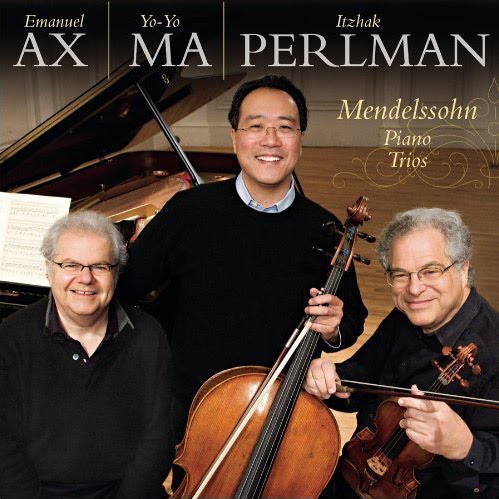
I just listened to the new album of Mendelssohn Piano Trios by Itzhak Perlman, Yo-Yo Ma, and Emanuel Ax. I got it mostly out of curiosity - I saw the album at the University Bookstore and was actually surprised to see Itzhak is still putting out recordings. His last few albums have mostly been re-issues (see here or here. The last album of his that I can remember that actually has new material is a Mozart one in which he plays Mozart 3 and then conducts the Jupiter symphony with the BPO (note that is off the top of my head - I could definitely be wrong about this). That one, to put it mildly, may not have seen Itzhak in the best light.

One of the three is not like the other

Not only was I surprised to see Itzhak recording again, but it was equally pleasantly surprising to see him paired with Yo-Yo. Since I really love the first Mendelssohn Trio (and the second is not so bad either), I really wanted to see how this would compare with my favorite recording (currently the Heifetz-Piatigorsky-Rubinstein one).

Let me first start by saying the general atmosphere that the three establish is very restrained and prohibitive. The three never really hit highs or lows, but instead try to deliver an understated performance. Compared with the firecracker Heifetz-Piatigorsky-Rubinstein, this one is a lot slower and less energetic. These are not necessarily bad things. In the second theme of the first movement of the first Trio for instance, I really feel like I get time to savor the beautiful melody. I also really like that Perlman is not in a hurry. That's not to say that he was slow or slowing down, but it did seem like he was consistently behind the beat when he wanted to be; the effect is nice and in stark contrast to everything Heifetz ever played. Further, the piece is kind of melancholy anyway, and I think the strategy taken by the three performers is actually justified.

Yo-Yo is fantastic. His openness and warmth of sound are made for these pieces. Itzhak doesn't have quite the bright and powerful tone that he used to, but he does manage to keep up. I must admit that I very rarely notice the pianist in piano trios, but Ax seems to do all the right things. Overall, I like the recording very much, but it didn't blow me away. The best way to describe my reaction is that it surpassed my low expectations. Why low? Because I have seen Itzhak Perlman perform live recently, and I have seen the debilitation in his technique and sound. Mendelssohn's Trios are actually perfect for him at this point because they don't require technical fingerboard gymnastics, and the climaxes are almost always in unison with the cello part.

This leads (finally) to the main point of the post. We were totally robbed of Itzhak and Yo-Yo. These two should have found each other 30 years ago and recorded the entire catalog of Piano Trios and other chamber music with each other. They have similar styles - big booming voices with an eye toward the dramatic while staying more or less conventional. Given the right pieces (such as the Archduke Trio or the Ravel Trio, just to name a few), these two would have built on each other and transcended the genre.

Instead, because of record label contracts (Itzhak was an EMI guy for most of his career, Yo-Yo has been with some form of Sony for his whole career), these guys only hooked up one previous time, and that was only possible because it was on Barenboim's label. (PS. I loved that recording. Itzhak did some quirky stuff in the Mendelssohn because it was a live performance, and Itzhak and Yo-Yo more or less fought each other for the title of "biggest sound produced" in the first movement of the Brahms Double). It took this long for Itzhak (now in his mid-60's) to finally team up with Yo-Yo.

Now, admittedly, they started teaming up in the mainstream earlier this decade, with the 2000 Oscars performance and more recently the Obamauguration. But even then Itzhak was losing his fastball. Looking back, his career peaked in the 80's (see: the first Brahms recording with Giulini, or the Beethoven Sonatas set he did with Ashkenazy). Yo-Yo more or less peaked in the 90's, but he has sustained a lot of his tone and skills.

What's up with the white turtlenecks?

This also brings me to a huge what-if for me. The Tchaikovsky Piano Trio recording with Perlman, Vladimir Ashkenazy, and Lynn Harrell is one of my five favorite music albums of all time. It goes on the desert island, and I don't even know what goes with it as of right now. I just know it's there. The music is so passionate and the three do such a perfect job of give and take. It is also Itzhak at his absolute apex, when he could make a climax sound like a mountain crashing in on itself. The recording was made in the early 80's. I know Yo-Yo was a little younger then, but wouldn't he have at least matched Harrell's performance?

The same goes for Yo-Yo. He recorded quite a bit of chamber music with Isaac Stern when Isaac was nearing the end of his career. In those recordings, Isaac was clearly a step below his prime, as he often played out of tune and had a very muted sound with little vibrato.

I'm happy that they are playing together now. However, I can't shake this feeling that we could have had a treasure trove of chamber recordings with the greatest violinist and cellist of the past 50 years consistently teaming up. Imagine them doing the Beethoven Piano Trios with Ashkenazy, or the Trout, or the Ravel duo. Sadly, this will have to be filed under one of the better musical what-ifs: what if Itzhak Perlman and Yo-Yo Ma had been under the same record label?

July 21, 2009

Mahler 9 at Ravinia

It is terrifying, and paralyzing, as the strands of sound disintegrate ... in ceasing, we lose it all. But in letting go, we have gained everything.
- Leonard Bernstein

It is music coming from another world, it is coming from eternity.
- Herbert von Karajan

I love the fact that I was able to find two quotes from diametrically opposite musicians, both of whom express the essence of Mahler’s Ninth better than I could. The truth is there is no shortage of great Mahler 9 quotes; hell, Lewis Thomas even wrote an essay describing his feelings for Mahler 9 and how they were irrevocably changed by his views on the Cold War.

After seeing Beethoven 9 on Saturday, I moved (upgraded?) to Mahler 9 on Sunday. I was back in the pavilion, in a nice seat toward the back but right in the middle so I could basically see everything. On a miserably cold Chicago summer day, Mahler 9 brought clarity and perhaps even hope to the viewers.

Mahler wrote his Symphony No. 9 directly after the Das Lied von der Erde, which the CSO played the previous weekend. In Das Lied, the text speaks of returning to the planet upon death and consequently rebirthing every spring. In Das Lied, Mahler is merely exploring his mortality; in the Ninth, he sees it eye to eye.

There is no doubt that Mahler intended for this symphony to be, if not his farewell symphony, then at least his symphony about Death. This analysis was already done in great detail by the great Mahler biographer Henry-Louis de La Grange (incidentally, that is a great place to read up on analysis of all of Mahler’s works).

Psychedelic Mahler

I will stick with what stood out to me. The first movement was well-played and well-paced. Conlon shaped the climaxes expertly, as each one showed something slightly different. The second movement was good, with the bassoons playing their solo theme with great precision and quality of sound.

The third movement is like a virtuoso piece for orchestra. It’s fast, chromatic, loud, and strident. The CSO played fantastically and were completely into it. They took a slightly faster tempo than convention, and I loved the result. I could see the entire orchestra moving as one in the few places when all the parts would converge into a unison line for a few seconds before diverging again. This was exciting music played by the world’s best who were actually trying to play their best.

Because they had set off the third on such a frenetic, driving pace, there was a lot more contrast when they finally hit the little patch near the end of the movement in which the theme for the fourth is first introduced. This was amazingly effective – the cry of this melody sung out compared to the shouts preceding it.

To which we reach the fourth movement. Let me just state that for me probably nothing will ever top the two Bernstein recordings of Mahler 9 when he was at the height of his powers (that is, he had reached his musical maturity and hadn’t yet come to his musical senility) – with the Boston Symphony Orchestra at Tanglewood and with the Berlin Philharmonic, both live performances in 1979, recorded months apart. Bernstein is the perfect representative for the fourth movement; he possesses the emotional capacity to wring out every last bit of heart-rending thought from the piece, and he also possesses the musical intelligence to shape the climaxes so they build on each other.

Wanna hear Lenny injure himself?

I love the fourth movement. Mahler basically sings at the top of his lungs for the entirety, the intensity never waning until the end. Throughout this outpouring of singing, the music slowly builds, like a wave gathering strength, until it finally reaches the second and final major climax.

The climaxes to me are the points in the movement when the strings are suspended in air with their held notes, just waiting to come down to the resolution (this also happens right at the beginning of the movement). Conductors can and do milk these climaxes, forcing their audience to wait for the final resolution. However, it’s absolutely the sign of an orchestra that is in sync to be able to do that. It requires professionals that are able to react to the slightest hint from the conductor of a movement in notes. Bernstein was the master of this. Conlon actually did quite well.

The passage described above occurs three times, once in the beginning, then the two major climaxes later on. Conlon held out more the further he got into the piece. In the beginning, he did the passage nearly in time. By the end, the entire hall was waiting to see Conlon move. I absolutely loved it, and the final climax was exactly what I believe Mahler intended it to be – all the energy is spent, all the emotion has escaped, and now one can accept Death. After the weight of the final climax from the CSO, I was able to accept the final few minutes of the death, as the strings and winds slowly brought the piece to an end.

My praise for Conlon in this performance has thus far been effusively positive, but I’d be remiss not to mention what I perceive to be his biggest weakness. He simply does not excite me as a conductor. He strikes me as a very mechanical and exacting professional, although I have no evidence of that. He obviously loves Mahler’s music very much; I just wish he would open up and really live in the moment – I think the CSO would respond well to it.

Contrast Conlon with Bernstein (I know, it’s like comparing a Hyundai to a Mercedes, but still). In the aforementioned Bernstein-BPO performance, Bernstein gets so worked up when the buildup to the second climax begins that he actually falls off the podium.* Conlon merely started waving his arms a little faster. I just want to see him move and respond a little bit – from my viewpoint, the CSO gave him so much, and he didn’t give back.

* I want to explore this recording in much greater detail later on, but for now, I want to mention that it definitely sounds to me like he falls or at least trips up somehow. I sometimes can even make out him saying something like “I’m alright” after the tumble.

Robert Chen, Charlie Pikler (especially), and the horns section were amazing in solos. I’ve been going to Chicago Symphony Orchestra concerts for the past 4 years, and I’m still routinely awed by the power and significance of the horn sound, and in general the brass sound. Also, please keep in mind that the CSO had just finished Beethoven 9 the previous night, less than 24 hours ago (!). That they were able to come back from that quick turn and play a more difficult piece at an even higher level makes it easy for me to say that the CSO is the best in the world (of course, I haven’t seen anyone in Europe live in concert yet, so my opinion is crap).

I felt a longer silence than usual between the conclusion of the piece and the start of the applause (avec standing ovation). I think we all needed to assess what was just witnessed – I saw it as one man’s terrifying vision of death turned tranquil and just. Mahler’s Ninth shows us we should not be scared of Death; instead it is the right and inevitable result at the end of a long and fulfilling journey.

The conclusion of Mahler’s Ninth
July 20, 2009

Beethoven 9 at Ravinia

Saw the CSO perform Beethoven's ninth last weekend. This was basically the first time for me to see it live. I had seen the Duluth Superior Symphony Orchestra do this piece a long time ago (maybe when I was 11 years old, before I had reached any kind of musical consciousness). This also marked the first time I saw a CSO-Ravinia concert on the lawn because they didn't offer student discounts for this one.

The program started with Copland's Fanfare for the Common Man. This piece is naturally a cinch for the CSO brass, and it was highly enjoyable. Next came Copland's Lincoln Portrait. This is an interesting piece, with a narrator describing Lincoln and some of his speeches. The Chicago Metropolitan Symphony Orchestra did this last year, and our narrator (Dan Laino) did an amazing job, subbing in at the last minute and delivering an emotional performance. Jessye Norman narrated for the CSO; while she ably performed the role of narrator, I found her to be a little dry and detached - along with the CSO. There are some incredible climaxes in this piece, and I feel like the CSO didn't really reach high on them.

It would've been fun to see a deaf Beethoven conduct the Ninth

My overall impression of the Beethoven was that the performance was very good and met my expectations for how the piece should feel. The first three movements didn't make much of an impression on me, even though they represent great music and I love listening to them. I think this was because we sat on the lawn (albeit extremely close, literally as close as can be to the pavilion). The listening experience is just not as intense on the lawn - people talk out loud, you have less to focus on and more distractions, and we brought food. I was not exactly captivated.

However, a wonderful moment took place in the last movement, which basically redeemed my experience. The concluding movement starts with conflict and remains so for a few minutes. Then, almost magically, when the cellos came in with the famous Ode to Joy melody, the entire place stopped. All the little chatter ceased, and everyone stood still. The cellos only have this line for about 30 seconds, but nobody dared to move for those 30 seconds, instead taking in the absolutely glorious music.

After that, I was obviously hooked. Starting from when the Bass soloist finally comes in, I watched the performance from the back of the pavilion with a pretty good view. There really is nothing quite like watching incredible music with so many people. At the end of the performance, I nearly got clubbed by a couple among people around me, who instantly whipped their arms up to celebrate/applaud.

As for the actual performance, I don't feel like the CSO performed better than usual, or with more excitment/passion. If anything, they seemed a little flat all night. There were many sections in which the strings were not together and nearly fell apart. That was probably just part of the summer orchestral experience. Conlon was his usual self (boring), although he did a great job making sure the choir was in sync with the orchestra, something that doesn't even go right in recordings someimt.

The soloists were decent. My favorite part of the symphony is near the end of the last movement when the soloists last sing as a quartet. This whole section is strange, because the four voices are seemingly all singing their own lines with no real rhyme or reason. This all kind of comes together when the soprano reaches up and hits that high B, and then order is restored again by the orchestra. Done right, this can be incredibly poignant. The soloists didn't really shine here, and unlike in some recordings I've heard, they sounded actually out of sync with each other, instead of just giving the impression that they were out of sync.

Those are just nitpicks. I still need to see this in a proper music hall setting, if only so I can concentrate the whole time and get the full sound experience. However, I wonder if the visceral, emotional feeling would have still been there had I been seated in a chair the whole time instead of rubbing shoulders against complete strangers, all standing behind the pavilion and stretching their necks to get a good look at the stage. I am glad I was able to share my first real Beethoven 9 experience with so many people, as we all collectively celebrated an Ode to Joy.

July 12, 2009

Octet Rehearsal

We rehearsed the Mendelssohn Octet again today. This was our second rehearsal, and the first with our second violist.

The first half we really worked hard on the first movement. I made the mistake of starting off too slow - it only lead to a lack of energy and more slowing down. We actually played technically better at a faster pace; maybe it forced us to concentrate more. We are still having some issues with soloistic playing. Not everyone is taking ownership of their solos when they have them. Hopefully that'll change as we get a better sense of what the piece is about. We also spent the majority of our time working through the development section (and the second theme) up to the big flurry that leads into the recapitulation.

We focused on the second movement for the last half. I was extremely impressed at the amount of progress we made on this in just an hour. There is a pretty nasty section in the middle when the octet is divided into two 4-person groups, and everyone is playing in kind of a round. This was extremely difficult to coordinate until we figured out the pattern (i.e. who played after whom). This was also another case of us playing much better at a faster tempo. Here, it probably just helps us maintain our momentum. We still slow down quite a bit in the two sublime melody sections in which different instruments take turns coming in while the chordal progression changes bit by bit.

I tried to be much more open in my playing today, looking all around. I definitely have a better sense of who plays with me and when now. It's still really hard to figure out who to look at among 7 choices, especially because most of the time it's more than just two people that are playing together. I also finally hit the high E-flat at the end of the first movement.

July 10, 2009

Mahler's Song of the Earth at Ravinia

One of the saddest things about leaving this world is not hearing Das Lied von der Erde ever again.
- Jascha Horenstein, shortly before his death in 1973.

I attended the Chicago Symphony Orchestra concert at Ravinia tonight, featuring Mahler's Das Lied von der Erde. It's the first time I've heard Das Lied live in concert, and despite the long and rather directionless take by conductor James Conlon during the last movement, I still left inspired.

It was my first Ravinia concert of the year. Let me emphasize that for students, a Ravinia-CSO concert is one of the best values in the Chicago area. For $10, I purchased a pavilion ticket in row H. With this ticket also comes access to the Steans Institute recital before the main concert event. The Steans Institute is a summer program for gifted young musicians to get together to study and perform chamber music. Tonight, I saw wonderfully gifted young musicians play Dvorak's Piano Quartet in E-flat and the sublime Schubert String Quintet in C.

It's always a pleasure listening to these young musicians. They are not the most polished; for example, there are moments when they are unable to blend their sound with the group or are not entirely sure who they should be looking at. However, they are all so technically gifted and exciting in their playing that it's still a fun watch.

The CSO played Mendelssohn's Symphony No. 4 "Italian" in the first half. I hadn't seen the CSO perform in a few months, and I was immediately reminded of their strengths. Despite having ~50 strings on stage, they played more cleanly and more as an ensemble than 5 Steans Institute kids could. I was told once that you can tell an orchestra is really good when the strings all play in the same part of the bow. This is actually a pretty underrated attribute for orchestras. It shows the musicians are disciplined (they are constantly looking to the front desk and mimicing them) and that they have played with each other a lot as a group. The CSO is exquisite in this regard.

Mendelssohn's "Italian" Symphony is one of those pieces that CSO musicians can play in their sleep. This is actually one of the downsides to these summer concerts - sometimes the musicians are on auto-pilot and don't respond to Conlon's conducting. The CSO didn't seem especially interested playing the Mendelssohn. However, that all changed in the second half.

Mahler had to give up hiking after learning about his heart condition

Some quick background on Mahler's Das Lied. It's basically Mahler's ninth symphony, as he wrote it after the eighth. There is speculation that Mahler didn't name it the ninth symphony because of the so-called Curse of the Ninth. It's scored for a very big orchestra with two vocal soloists.

Translated as "The Song of the Earth", Mahler based the work on some ancient Chinese writings. The work is meant to celebrate life on Earth (drinking, love, fun) and death. The last movement is titled "The Farewell" and evokes an acceptance of death. It is the same length (~30 minutes) as the preceding five movements.

Mahler started work on this piece one year after he had received the three "hammer blows" that he had grisly predicted on himself in his tragic sixth symphony. First, he was forced to resign his post as Music Director of the Vienna Court Opera due to anti-semitic pressure against his Jewish upbringing. Next, his eldest daugher Maria died from sickness. Finally, Mahler was diagnosed with a heart defect that the doctor predicted would soon lead to his death.

Forced to face his own mortality, Mahler essentially reacted through his music. In Das Lied, Mahler seems to come to the understanding that in death, people return to the Earth, which in turn is able to renew itself every Spring.

The soloists were Michelle DeYoung and Stuart Skelton. Skelton was quite good, with a booming voice and facial expressions that matched well with the content of his singing. DeYoung shocked me with a strong and operatic sound. I had seen DeYoung perform the role of Brangäne in Wagner's Tristan und Isolde. I couldn't quite get that image out of my head. She is almost the perfect Wagnerian "it ain't over til the fat lady sings" soloist. Her talent seemed incongruous with the nature of Das Lied. Whereas the piece requires the soloist to show subtlety, DeYoung is almost always "on". This was especially apparent in the last movement, as DeYoung had trouble in dying down with the rest of the orchestra.

Conlon did a fine job overall, considering the difficulty. The last movement is essentially a 30 minute meandering cadenza. There is little structure to it, so a conductor needs to be very careful in how he shapes the architecture of the movement. Unfortunately, Conlon doesn't do this well; when the music builds, it seems artificial, as if the musicians are only doing it because it is required of them on the page. There is no expectation of buildup, so when it does happen, it is suprising, almost jarring, which is not the intent of the music. Again, this is a very hard problem to solve - look up Jascha Horenstein's recording to hear it done right.

The CSO played very well and with passion. I was especially impressed by the lead flautist Mathieu Dufour, who played a big role in the last movement of Das Lied. I was somewhat disappointed though that they went with such a huge orchestra for Das Lied - I counted 14 firsts and 12 cellos. Das Lied is really a chamber piece in disguise; even though it requires a large range of instruments, rarely does the whole orchestra play together, and even then a huge sound is not really called for. Schoenberg actually arranged a version of Das Lied for chamber orchestra, which sounds amazing in the hands of Philippe Herreweghe.

Despite all this, I was all goosebumps at the conclusion. Mahler's magical touch in slow movements prevailed, and I have Mahler 9 to look forward to for next weekend.